
Knowledge Paper 028 · Consumer Research
Why So Much Market Research Gets People Wrong
The problem is not that consumers lie. It is that they don't always know why they do what they do, but make up explanations, anyway.
The short answer
Businesses spend enormous amounts asking customers what they think.
What do you like?
Why did you buy this?
Would you buy that?
Which advert do you prefer?
What would make you switch?
Would you pay more for this feature?
It all sounds perfectly reasonable.
There is just one problem.
Human beings are not particularly reliable witnesses to their own behaviour.
We make many decisions quickly, automatically and in response to things we barely notice.
Context.
Habit.
Familiarity.
Other people.
Price.
Packaging.
Availability.
Memory.
Mood.
Then, when somebody asks us why we did what we did, the conscious mind produces an explanation.
Usually a perfectly plausible one.
But that doesn't necessarily make it true.
The book that changed how we think about consumers.
Philip Graves published Consumer.ology in 2010.
It became one of the biggest influences on my own thinking about marketing and consumer behaviour over the years that followed.
The book's subtitle says exactly what it is trying to do:
The Market Research Myth, the Truth about Consumers and the Psychology of Shopping.
Graves' argument is deliberately provocative.
Conventional market research rests heavily on an assumption:
Ask people what they think, what they did or what they might do in future, and their answers will tell us something dependable about their behaviour.
Graves argues that this assumption is much shakier than the research industry likes to admit.
Not because people are stupid.
Not because they are dishonest.
Because much of human behaviour is shaped by processes to which conscious introspection has limited access.
People do not buy the way they say they buy.
Ask somebody how they choose a washing machine and you will probably get a sensible answer.
Price.
Capacity.
Spin speed.
Energy efficiency.
Reliability.
In Consumer.ology, Graves describes observing shoppers confronting around forty visually similar washing machines and hundreds of potential pieces of information.
The apparently simple rational decision became cognitively overwhelming.
People filtered options.
Defaulted towards familiar brands.
Allowed salespeople to simplify the decision.
Or walked away.
Yet afterwards they could still produce perfectly plausible explanations for what they had chosen.
The conscious mind is a press officer.
This may be the easiest way to understand the problem.
The unconscious mind does an enormous amount of work.
The conscious mind explains what happened afterwards.
Think of it as the brain's press officer.
Something happens.
A choice gets made.
Then somebody sticks a microphone in front of us and asks:
“Why?”
And the spokesperson produces a respectable story.
Graves discusses a famous study in which people evaluated four pairs of tights.
The products were identical.
But their physical position strongly influenced which pair people preferred.
When asked why they had chosen one pair over another, respondents talked about sheerness, knit and elasticity.
They didn't say:
“I chose it because of where it was sitting.”
Almost nobody even noticed the tights were identical.
They were not necessarily lying.
They were explaining.
There's a difference.
Evolution built an automatic brain.
Thinking is expensive.
If our ancestors had consciously reconsidered every berry, every footstep, every familiar face and every possible threat from first principles, they would not have achieved very much.
Natural selection favoured organisms capable of automating familiar decisions.
Recognise the pattern.
Use what worked before.
Move on.
Modern consumer behaviour inherits the same machinery.
The supermarket shelf may be new.
The underlying brain is not.
We scan.
Recognise.
Default.
Copy.
Avoid loss.
Follow familiar cues.
Respond to context.
Often before deliberate reasoning becomes heavily involved.
Graves makes the evolutionary point explicitly: automating familiar, low-risk decisions frees attention for more important problems.
A familiar product can effectively become the modern equivalent of the berry from the bush that did not poison you last time.
Context is part of the decision.
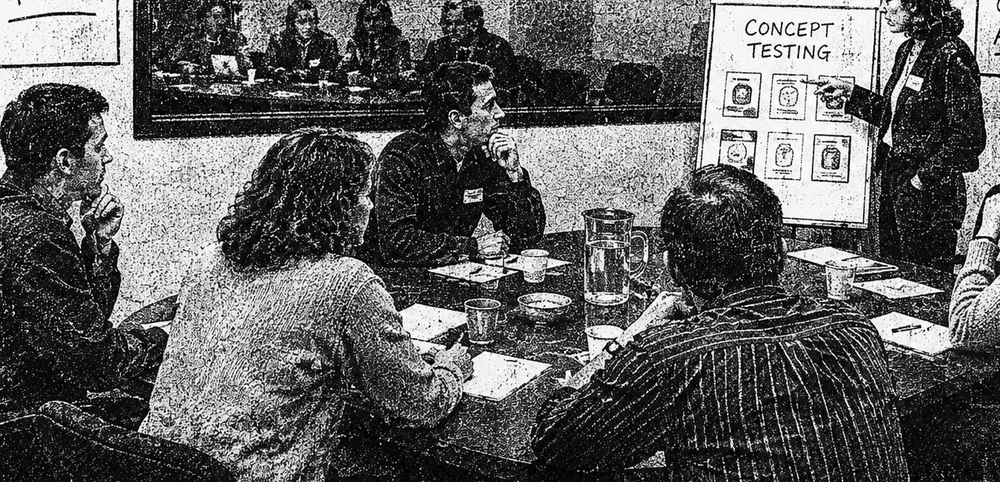
This may be the biggest practical weakness in traditional market research.
Take somebody out of a restaurant, shop, website, airport or supermarket.
Put them in a fluorescent room.
Give them coffee and prawn sandwiches.
Show them a concept board.
Ask what they would do.
You've removed the environment that helped create the real behaviour.
What was beside the product?
Who were they with?
Were they rushed?
Were they hungry?
What did they see first?
What did everyone else appear to be buying?
What was the price?
What had they bought before?
Was their child screaming?
Was it raining?
Those are not peripheral details.
They are part of the decision.
The focus group creates the thing it claims to discover.
Focus groups supposedly reveal what people think.
But putting a group of strangers together and asking them to discuss something creates an entirely new social environment.
People copy one another.
Conform.
Change opinions.
Follow confident speakers.
Respond to the moderator.
Seek social approval.
Graves' criticism is not just that focus groups are artificial.
It is that the artificial social situation itself changes what people think and say.
New Coke is the perfect warning.
The New Coke story has become marketing folklore for good reason.
Pepsi had been beating Coke in blind taste tests.
Coca-Cola developed a sweeter formulation.
In testing, it beat Pepsi.
The research looked encouraging.
Then 'New Coke' replaced the original product.
Consumers revolted and sales tanked.
The original formula returned within months.
The interesting lesson is not merely that one piece of research was badly designed.
The research environment removed much of what Coca-Cola actually meant in the real world.
Brand.
Memory.
Habit.
Identity.
Packaging.
Loss aversion.
Social proof.
The difference between trying something once and drinking it repeatedly.
The research measured:
Which cola tastes better here?
The marketplace answered:
What does Coca-Cola mean to me?
People are terrible at predicting their future selves.
One of the most common research questions is also one of the most dangerous.
“Would you buy this?”
There is almost no cost to saying yes.
No money changes hands.
No competing product is present.
No habit needs to be broken.
No risk exists.
No opportunity cost exists.
The respondent can imagine themselves as the sort of person who would buy it.
Then launch day arrives.
Now the money is real.
The existing habit is real.
The alternative product is real.
The risk is real.
And behaviour may look completely different.
Market research can create false confidence.
The dangerous thing is not simply getting the wrong answer.
It is getting the wrong answer with a number attached.
200 people said this.
73% preferred that.
Eight out of ten respondents agreed.
Four focus groups reached consensus.
Numbers look authoritative.
Statistics look scientific.
Consensus feels like truth.
But sophisticated analysis can't repair a flawed premise.
Good mathematics applied to poor inputs still produces poor conclusions.
Sometimes reassurance is the product.
There is also an organisational reason market research is so attractive.
It makes decisions defensible.
If an initiative succeeds:
“The research was right.”
If it fails:
“At least we did the research.”
That changes the role research plays inside companies.
Sometimes it genuinely improves the decision.
Sometimes it reduces personal exposure if the decision turns out badly.
The appearance of due diligence can become more valuable internally than genuine understanding of consumer behaviour.
So is all market research useless?
No.
That would simply replace one simplistic belief with another.
Research can be extremely useful.
The important question is:
What are we actually asking people to tell us?
People can tell you:
- the toilets were dirty
- the website crashed
- the delivery arrived late
- they could not find the booking button
- the menu was confusing
- the product broke
- they remember seeing an advert
Those are relatively direct observations and experiences.
The danger grows when we ask:
- Why did you choose us?
- What will you buy next year?
- Which product concept will succeed?
- What unconsciously influenced you?
- Which advert will make you purchase?
Now introspection is being asked to perform a task it's not be capable of doing accurately.
Observe first. Ask second.
Graves' alternative is much closer to behavioural science.
Observe what happened.
Understand the context.
Look for patterns.
Change something.
Test it.
Watch what happens next.
And then use questions to illuminate what you have already observed.
Where possible, live testing is far more powerful than asking somebody to imagine what they might do.
Put a real choice in front of them.
Introduce a real cost.
Let familiar habits compete with the new behaviour.
Then measure what happens.
The Consumer Research Reality Gap.
MRX
PROBLEM
We're asking the explanation to tell us what caused the behaviour.
TheSignalWorks Research Test.
Before commissioning research, ask seven questions.
Could we observe what people actually do instead?
Are we studying people in anything resembling the environment where the real decision happens?
Are we expecting somebody to accurately reconstruct something they barely noticed at the time?
Are we asking people to explain unconscious or habitual behaviour?
Does answering this question involve any real cost, risk or consequence?
Is the research situation itself changing the person's response?
Could we run something small in the real world and measure behaviour?
Common mistakes.
Asking people why they bought something.
The explanation may be sincere without accurately identifying the causes of the behaviour.
Asking people what they will do.
Hypothetical intentions don't include the real costs, habits, risks and alternatives present at the point of purchase.
Removing people from the buying environment.
Context isn't noise around the decision.
It's part of the decision.
Treating consensus as truth.
People responding consistently to the same research process doesn't automatically mean the answer reflects real behaviour.
Using focus groups to predict success.
Group dynamics can create conformity, social proof and opinions that probably don't exist outside the room.
Researching when you could test.
A real-world behavioural experiment will tell you more than a hypothetical discussion.
Using research to remove responsibility.
Research should reduce uncertainty, not provide organisational cover for decisions.
TheSignalWorks View
Research is valuable.
Reassurance is not the same thing.
Consumers are not idiots.
They are not dishonest.
They are not irrational.
They are human.
Much of what they do is fast, contextual, habitual, emotional and socially influenced.
Those mechanisms evolved precisely because consciously analysing every possible action would be impossibly inefficient.
So asking the conscious mind to explain all of consumer behaviour is like asking the press secretary to explain every process occurring inside government.
You will get an answer.
It may even be convincing.
That does not mean it is how the decision was made.
The job of research should therefore not be to collect more opinions.
It should be to reduce uncertainty about behaviour.
Watch.
Test.
Compare.
Experiment.
And ask questions only where questions can genuinely help.
Because ultimately the most reliable answer a customer can give you is not always what they say.
It is what they do.
Key Takeaways
- Consumers are often poor witnesses to the causes of their own behaviour.
- People can sincerely rationalise decisions without identifying what actually drove them.
- Context, habit, familiarity and social influence are often central to consumer choice.
- Research environments can change the behaviour or opinions they are supposedly measuring.
- Hypothetical purchase intentions should not be treated as equivalent to real purchasing behaviour.
- Statistics can create false confidence when the underlying questions are flawed.
- Observation, behavioural data and live testing should usually be preferred when they are practical.
- Questions are most valuable when grounded in recently observed behaviour and real context.
Frequently Asked Questions
Does this mean market research is useless?
No.
It means research needs to be matched to questions people can reasonably answer.
Why are consumers bad at explaining their behaviour?
Because many decisions involve automatic, contextual and unconscious processes that are not directly available to conscious introspection.
Are consumers lying in research?
Usually not.
People can give an entirely sincere explanation that is nevertheless an inaccurate account of what caused their behaviour.
Why are focus groups problematic?
The group itself creates social influence, conformity, priming and discussion effects that can change what participants think and say.
What should businesses do instead?
Observe behaviour, analyse real-world data, conduct experiments, use live testing where possible and ask questions close to the actual behaviour and context.
Can customers tell us anything useful?
Absolutely.
Customers can often accurately report direct experiences and observable problems. Research becomes less dependable when it asks them to identify unconscious causes or predict hypothetical future behaviour.
What is the main lesson from Consumer.ology?
That understanding consumers requires paying much more attention to what people actually do, the context in which they do it and the psychological processes shaping behaviour — rather than relying solely on what people say they think.
Further Reading
- Philip Graves — Consumer.ology: The Market Research Myth, the Truth about Consumers and the Psychology of Shopping
- Timothy D. Wilson — Strangers to Ourselves
- Daniel M. Wegner — The Illusion of Conscious Will
- Joseph LeDoux — The Emotional Brain
- Daniel Kahneman — Thinking, Fast and Slow
- Robert Heath — work on Low Involvement Processing
Related Knowledge
About TheSignalWorks
TheSignalWorks applies marketing science, psychology and behavioural evidence to the practical problem of understanding how people really choose.
Because if you want to understand consumers, asking them is sometimes useful.
Watching them is much better.