
Knowledge Paper 012 · CONSUMER PSYCHOLOGY
What Is Low Involvement Processing?
Why advertising can work even with very little attention.
The short answer
Ask someone if they remember every roadside billboard they passed on the way to work this morning.
Most will not.
Now ask them where the nearest McDonald’s is.
They will almost certainly know.
That is the paradox.
Advertising does not always need your full attention.
Sometimes it simply needs your brain to notice that it exists.
The myth of attention.
Modern marketing talks constantly about attention.
Attention spans.
Attention economy.
Attention metrics.
As though advertising only works when people consciously engage with it.
Robert Heath argued something rather different.
Most advertising is processed under conditions of low involvement.
People are not analysing every message.
They are making dinner.
Driving.
Watching television while scrolling.
Talking.
Thinking about tomorrow’s meeting.
Advertising slips into the background.
Yet it still leaves traces.
Your brain never really switches off.
From an evolutionary perspective this makes perfect sense.
For our ancestors, the environment constantly contained useful information.
Where food might be.
Where danger might be.
Who belonged.
Who did not.
The brain evolved to monitor its surroundings continuously.
Not every piece of information required conscious thought.
Many patterns were absorbed automatically.
Advertising exploits exactly the same machinery.
Memory is built from fragments.
This connects directly to our earlier papers.
A brand is not stored as a single memory.
It is assembled from fragments.
- A colour.
- A logo.
- A slogan.
- A jingle.
- A familiar shape.
- A roadside sign.
Each exposure adds another tiny piece.
Eventually those fragments become Mental Availability.
McDonald’s does not need your attention.
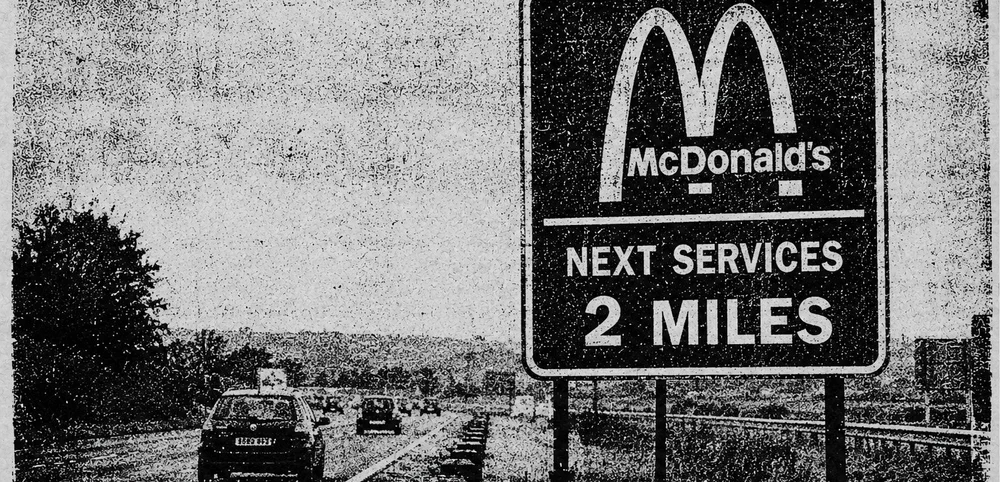
Imagine driving along a motorway.
You see a simple sign.
Golden Arches.
Next services: two miles.
You do not stop.
You barely think about it.
But your brain has already done the work.
It recognised the shape.
Linked it to food.
Linked it to convenience.
Linked it to familiarity.
The sign behaves less like an advertisement than a road sign.
It does not persuade.
It reminds.
Advertising is environmental.
Think about the best-known brands.
Coca-Cola.
Nike.
McDonald’s.
Google.
You do not consciously study them every day.
They simply exist around you.
Repeatedly.
Predictably.
Consistently.
Like landmarks in the landscape.
The cumulative effect is what matters.
Why repetition works.
People often complain that seeing the same advert repeatedly is annoying.
They are missing the point.
The advertisement was not made for someone who has already seen it fifty times.
It was made for millions of people, each at different stages of memory formation.
Repetition does not exist because marketers lack imagination.
It exists because memory strengthens through repeated exposure.
Why this matters.
Low Involvement Processing changes the way we think about advertising effectiveness.
The question is not always:
“Did people pay attention?”
Sometimes the better question is:
That is a very different standard.
It shifts the focus from immediate engagement to long-term memory.
From persuasion to familiarity.
From campaign response to future retrieval.
Common mistakes
Assuming attention equals effectiveness.
Some memorable advertising receives surprisingly little conscious attention.
Some highly engaging advertising leaves no lasting brand memory.
Constantly changing campaigns.
If every campaign looks different, the brain struggles to connect the fragments.
Consistency builds memory.
Novelty often destroys it.
Confusing entertainment with branding.
People may remember a funny advert while forgetting who paid for it.
The purpose is not simply to entertain.
It is to strengthen the brand.
Chasing clicks.
Clicks measure immediate behaviour.
Brands often grow because of memories formed months or years earlier.
TheSignalWorks View
One of the biggest mistakes in modern marketing is believing that advertising only works when people are paying close attention.
Human brains evolved to learn continuously from their environment.
Advertising is part of that environment.
Most successful campaigns do not win because people stop everything and analyse them.
They win because they become part of everyday life.
A familiar colour.
A familiar sound.
A familiar shape.
Repeated often enough, those fragments become memory.
And memory is what buying decisions retrieve.
Key Takeaways
- Advertising does not always require conscious attention.
- Low Involvement Processing explains how repeated exposure builds memory.
- Consistency is usually more valuable than constant novelty.
- Roadside advertising often functions more like navigation than persuasion.
- Mental Availability grows through accumulation rather than isolated moments of attention.
Frequently Asked Questions
What is Low Involvement Processing?
Low Involvement Processing is a theory developed by Robert Heath suggesting that advertising can influence people even when they are paying very little conscious attention.
Does this mean attention does not matter?
No.
Attention matters, but it is not the only route by which advertising works.
Memory can form under surprisingly low levels of conscious engagement.
Why are McDonald’s roadside signs so effective?
Because they function primarily as retrieval cues.
They reinforce existing memory structures rather than attempting to persuade people from scratch.
Does repetition really work?
Yes.
Repeated, consistent exposure strengthens memory and increases the likelihood that a brand comes to mind when buying situations arise.
Further Reading
- Robert Heath — The Hidden Power of Advertising
- Jeremy Bullmore — Posh Spice & Persil
- Byron Sharp — How Brands Grow
- Jenni Romaniuk — Better Brand Health
- Daniel Kahneman — Thinking, Fast and Slow
Related Knowledge
About TheSignalWorks
At TheSignalWorks, we build brands that work with the way people actually think, not the way marketers imagine they think.
Because the most powerful advertising is not always the loudest.
Sometimes it is simply the easiest to remember.