
Knowledge Paper 009 · Marketing Science
What is the 95–5 Rule?
Why most of your future customers are not buying today.
The short answer
Imagine you sell family cars.
At any given moment, how many people are actively looking to buy one?
The answer is surprisingly few.
Most families replace a car every four, five or even six years.
That means that, today, the overwhelming majority of potential buyers have no intention of visiting a dealership.
They are busy living their lives.
The 95–5 Rule captures this simple but profound idea.
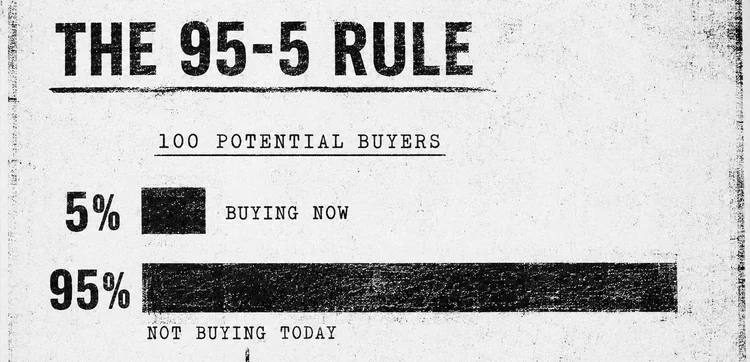
In many markets, particularly B2B and durable consumer goods, around 95% of potential buyers are out of market, while only around 5% are actively looking to buy.
The precise percentage varies by category, but the principle remains remarkably consistent.
Buying is an event, not a permanent state.
Marketing often behaves as though everyone is continuously making purchasing decisions.
They are not.
People drift in and out of markets.
One month they need a mortgage.
Five years later they do not.
One year they buy a new kitchen.
The next fifteen years they do not.
Demand is not continuous.
It arrives in waves.
Evolution did not build us to shop.
From an evolutionary perspective this makes sense.
For almost all of human history we acquired important possessions infrequently.
Shelter.
Weapons.
Clothing.
Tools.
Large exchanges happened occasionally, not constantly.
Our minds evolved to solve immediate problems.
Not to maintain permanent shopping lists.
Marketing therefore has an awkward challenge.
It must influence people before they need you.
Memory fills the gap.
This is where the 95–5 Rule connects directly to Mental Availability.
If someone is not buying today, they are unlikely to pay much attention to your advertising.
They are not evaluating suppliers.
They are not reading product comparisons.
They are not requesting demonstrations.
But they are still forming memories.
Every encounter leaves traces.
- A logo.
- A colour.
- A story.
- A slogan.
- A distinctive asset.
Months or years later, when they finally enter the market, those memories influence which brands come to mind first.
A car buying example.
Imagine two manufacturers.
Brand A advertises consistently for years.
You notice the cars on television.
You see them online and on billboards.
You recognise the badge.
You vaguely remember a campaign you liked.
Brand B disappears between launches.
Four years later your current lease ends.
Which brand feels familiar?
Which one seems trustworthy?
Which dealership do you visit first?
Very little of that decision was made in the week before purchase.
Most of it was built over the previous four years.
Why B2B is even more extreme.
The 95–5 Rule became well known through research by Professor John Dawes and colleagues into B2B buying.
A company may only change its payroll software once a decade.
Or appoint a new legal adviser every seven years.
For most of the time, they simply are not buying.
That makes continuous brand building even more important.
When procurement finally begins, buyers do not start from zero.
They start with the brands they already know.
Why this matters.
Performance marketing captures existing demand.
Brand building prepares future demand.
Both matter.
But they work on different timescales.
If all your marketing is aimed at people who are ready to buy today, you are ignoring most of tomorrow’s market.
That may feel efficient in the short term.
Over time, it leaves future growth underpowered.
Common mistakes
Optimising only for today’s buyers.
Performance marketing is essential.
But it only reaches people already looking.
Future buyers remain invisible.
Turning brand advertising off.
Many organisations stop investing in awareness when sales slow.
Ironically, that is when future demand is being built.
Expecting immediate results.
Brand building works more like planting an orchard than picking fruit.
The returns arrive gradually.
Then compound.
Assuming non-buyers do not matter.
Today’s non-buyer may be tomorrow’s highest-value customer.
The point is not whether they are buying now.
The point is whether they will remember you when they do.
TheSignalWorks View
The biggest mistake in marketing is assuming your market is always listening.
It is not.
Most people are busy.
Busy working.
Busy raising families.
Busy solving other problems.
The job of marketing is not to interrupt every buying decision.
It is to become the brand that memory retrieves when buying eventually begins.
The companies that grow consistently are not simply better at selling.
They are better at being remembered.
Key Takeaways
- Most potential customers are not actively buying today.
- The 95–5 Rule is especially relevant in B2B and durable consumer categories.
- Brand building prepares future demand while performance marketing captures existing demand.
- Mental Availability bridges the gap between advertising and future purchasing.
- Long-term growth depends on reaching today’s non-buyers as well as today’s buyers.
Frequently Asked Questions
Is the 95–5 Rule always exactly 95% and 5%?
No.
The exact proportions vary by category, purchase frequency and market conditions.
The principle is that only a small minority of buyers are in-market at any one time.
Does the 95–5 Rule only apply to B2B?
No.
It is particularly visible in B2B because purchases are infrequent, but the same logic applies to many consumer markets including cars, kitchens, furniture, insurance and household appliances.
Does this mean performance marketing does not work?
Not at all.
Performance marketing is excellent at reaching people who are already buying.
Brand building ensures more people think of you when they eventually enter the market.
How does the 95–5 Rule relate to Mental Availability?
Brand advertising builds memory while people are out of market.
When they later become buyers, those accumulated memories influence which brands they consider.
Further Reading
- John Dawes — research on the 95–5 Rule
- Byron Sharp — How Brands Grow
- Jenni Romaniuk — Better Brand Health
- Les Binet & Peter Field — The Long and the Short of It
Related Knowledge
About TheSignalWorks
At TheSignalWorks, we help organisations build demand before demand exists.
Because the best time to influence tomorrow’s customer is usually long before they realise they are looking.