
Knowledge Paper 031 · Pricing & Consumer Psychology
THE PRICE IS NOT THE PRICE
Why what something costs and what people think it's worth are two different things.
The short answer.
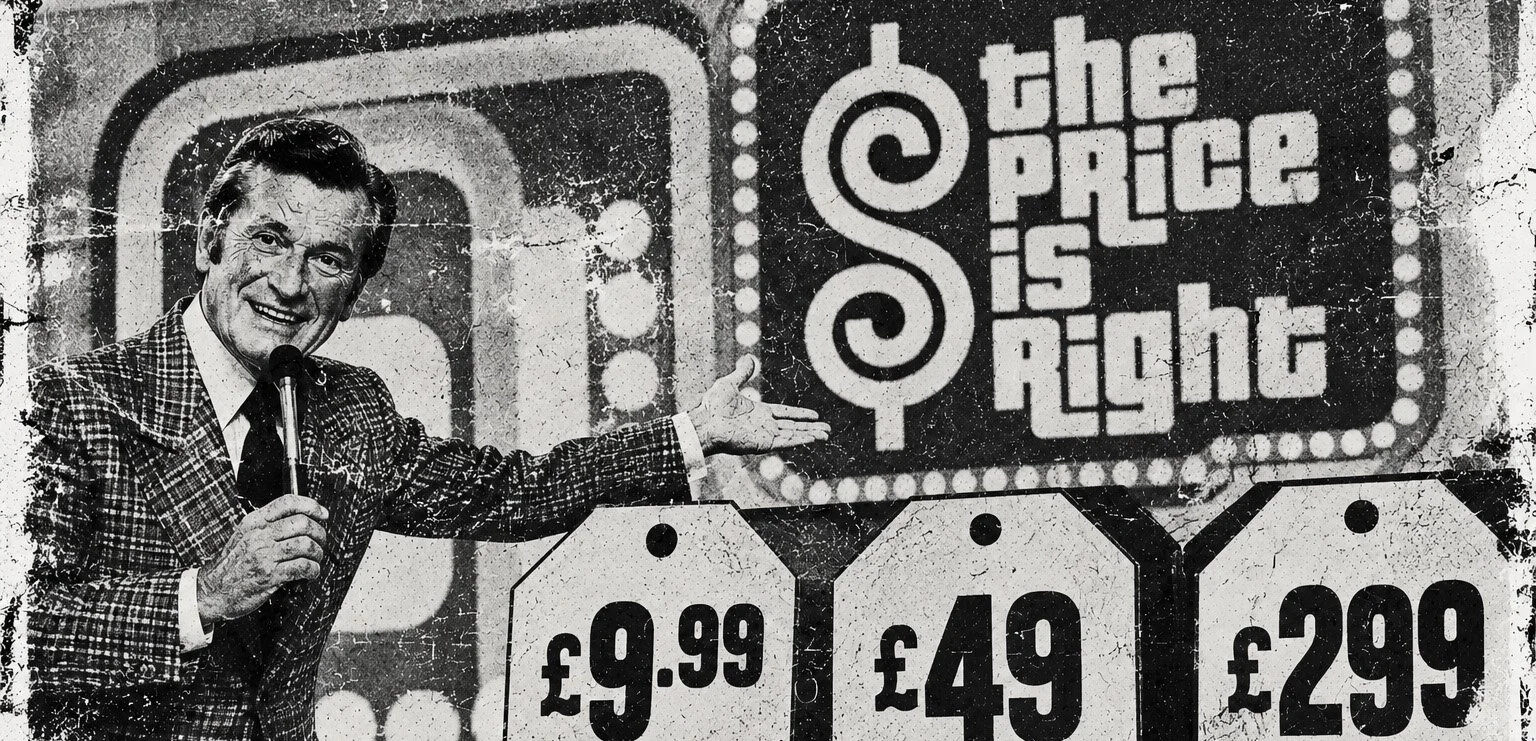
Come on down! The price is right. (Apologies, that's an obscure cultural reference only those of a certain age will get).
Pricing is tricky.
A £6 coffee can feel outrageous in a motorway service station and perfectly reasonable in a fashionable hotel. A £200 handbag seems expensive until it is sitting beside a £3,000 handbag. A £150 whisky might be an extravagance for an ordinary Friday evening and a perfectly sensible retirement present.
The number hasn't changed.
But what the number means has.
Economics tells us that, other things being equal, increasing a price tends to reduce demand. That's a useful starting point. But it doesn't explain why some consumers actively seek out expensive things, why a suspiciously cheap professional service can feel risky, or why a product can suddenly seem like a bargain simply because we've seen a more expensive alternative.
For that we need consumer psychology.
And to understand how pricing affects brand growth, we also need marketing science.
Nobody buys a price in isolation.
Marketers often talk about people as though price sensitivity were a permanent personality trait.
Some consumers are supposedly price-conscious. Others are premium buyers. Some want bargains. Others want luxury.
But human behaviour is a bit more flexible than that.
The same person can spend twenty minutes comparing supermarket prices to save £3 and then spend £200 on dinner without experiencing the slightest contradiction.
One purchase may be about efficiency and conserving resources. Another may be about celebration, generosity, social connection or making an occasion memorable.
From an evolutionary psychology perspective, this makes sense. Humans evolved to make decisions in changing environments, balancing competing goals rather than obeying a single purchasing personality.
We conserve resources when conservation matters. We display generosity when relationships matter. We may spend conspicuously when status matters. And we become more cautious when the consequences of making a mistake are high.
Behaviour that looks inconsistent when viewed through a conventional consumer segment may be perfectly coherent once the situation is understood.
What marketing science tells us about price.
Price has an obvious commercial effect. It changes the cost of buying and can change the number of people willing or able to buy.
But the Ehrenberg-Bass perspective introduces an important distinction between generating sales today and building a brand that continues to grow.
Price promotions can produce immediate sales increases. Discounts can attract category buyers, encourage switching and bring purchases forward.
However, the sales generated during a promotion are not necessarily all incremental. Some customers would have bought anyway. Others may buy earlier than planned or purchase extra stock that reduces their need to buy later.
And while price can influence brand choice, there is little reason to assume that a temporary discount automatically creates enduring loyalty.
Brands still need to build mental availability, making themselves more likely to come to mind in buying situations, and physical availability, making themselves easy to find and purchase.
Price can help someone choose a brand.
But first they need to see it, recognise it and be able to buy it.
The brain doesn't know what anything should cost.
For many purchases, people have only a vague idea of what a reasonable price should be.
They may know roughly what a loaf of bread costs, but what about a branding workshop, a rare whisky, a hotel suite, a bespoke kitchen or a management consultancy project?
In the absence of a reliable internal reference price, people use the information around them.
This is where anchoring and reference prices become important.
Show someone a £3,000 handbag and a £200 handbag may suddenly appear relatively affordable. Show a client a £1,500 consulting package and a £500 option may feel more modest.
The expensive option hasn't made the cheaper one objectively better.
It has changed the comparison.
And human judgement is heavily influenced by comparisons.
The decoy in the middle.
People don't always evaluate products independently. They compare the alternatives placed in front of them.
One interesting behavioural phenomenon is the decoy effect, sometimes called asymmetric dominance.
Under certain conditions, adding an option that is clearly less attractive than another can make the more attractive option more likely to be chosen.
Imagine a distillery offering three tasting experiences.
Introduction and guided whisky tasting.
Extended tasting with additional premium whiskies.
The premium experience with a souvenir tasting glass.
In this hypothetical example, the £65 option could make the £70 option feel like an attractive upgrade for someone who values the glass.
The additional £5 appears relatively small beside the overall experience.
This is an illustration of comparative evaluation, rather than proof that this particular menu would produce a decoy effect. A true asymmetric-dominance test would require carefully constructed alternatives and actual choice data.
The broader lesson is that the way options are presented can influence how their prices are interpreted.
Which is why pricing architecture can matter as much as the individual numbers.
When expensive becomes desirable.
Now things get really interesting.
Normally, a higher price discourages some buyers. But there are circumstances in which the price itself contributes to desirability.
In 1899, the economist and social critic Thorstein Veblen published The Theory of the Leisure Class, examining how conspicuous consumption could communicate wealth and social standing. By the way, reading Veblen will teach you a lot about internet culture even though he was wring in the 19th century...
The related economic concept of a Veblen good describes a product for which a higher price can, over some range, increase demand because the price contributes to its prestige.
Luxury watches, designer fashion, rare jewellery and other status-oriented products provide plausible settings for this behaviour.
But not every expensive product is a Veblen good, and not every luxury purchase is motivated by status.
There are several mechanisms worth distinguishing.
Price as a quality signal.
When quality is difficult to judge, people may use a higher price as evidence that something is better.
Price as a status signal.
Ownership may communicate wealth, taste, access or social position to other people.
Price as a barrier to entry.
Part of the attraction may be that relatively few people can afford or obtain the product.
These mechanisms can overlap, but they are not identical.
The evolutionary logic of expensive things.
Why would humans ever value something more because it costs more?
One explanation comes from costly signalling.
In evolutionary biology and psychology, a costly signal can convey information precisely because producing it requires resources, effort or some other meaningful sacrifice.
A peacock's elaborate tail is the familiar biological illustration. It is costly to produce and maintain, which may make it informative in ways a cheap signal would not be.
Human status displays are more complicated, but the underlying logic is relevant.
An expensive watch can communicate access to resources. An elaborate gift can signal generosity or commitment. A rare object can communicate cultural knowledge or membership of a particular social group.
Of course, people also buy expensive products for craftsmanship, pleasure, durability and personal satisfaction. Status is one possible motive, not a universal explanation.
And crucially, a high price is not automatically an effective signal. It must mean something to the intended audience.
A £20,000 watch only communicates prestige to someone who recognises the watch, the brand or the significance of its price.
Which brings us back to marketing.
Luxury brands still need reach.
It is tempting to imagine that luxury brands operate outside the normal laws of marketing.
They are exclusive, expensive and apparently supported by devoted communities of enthusiasts.
But within their relevant competitive markets, they still need to attract buyers, build distinctive memories and make themselves available in appropriate buying situations.
A luxury customer can also be a repertoire buyer, choosing among several fashion houses, watchmakers, hotels or prestige spirits depending on the occasion.
A high price may limit the economically addressable market. That is a genuine constraint.
But it doesn't follow that a luxury brand should deliberately restrict its communications to a tiny group of existing devotees.
Someone who cannot afford a particular product today may be able to afford it later. Someone who rarely buys luxury goods may nevertheless become a buyer for an important occasion.
The psychology of £9.99.
What about those familiar prices ending in nine?
£4.99. £19.99. £99.99.
Research into price endings suggests that, under some conditions, these prices can influence perceptions and choice. One proposed mechanism is the left-digit effect, where people give disproportionate weight to the first digit they encounter.
But this is not a universal rule.
£9.99 may communicate value in one setting while £10 feels simpler, more confident or more appropriate in another.
A prestige product may benefit from a round price. A discount retailer may benefit from a price that emphasises savings.
Neither approach guarantees success.
The important question is what the price communicates in the context of the category, brand and buying situation.
Pricing psychology is not a collection of magic numbers.
It is an understanding of how people interpret numbers.
Discounting: borrowing sales from tomorrow?
Discounts are seductive because their effects can be immediate and measurable.
Reduce the price, see the sales rise, declare success.
But the increase during the promotional period doesn't tell the whole story.
Some buyers may have switched from a competitor. Some may have bought more than usual. Others may simply have purchased something they would have bought next week anyway.
There may also be costs from reduced margins, stockpiling and conditioning customers to expect future promotions.
That doesn't make discounting inherently bad.
Promotions can support trial, clear inventory, stimulate short-term demand and help a brand compete in a crowded category.
The challenge is to distinguish genuine incremental growth from the temporary movement of sales between brands or across time.
Did the promotion create more profitable demand?
Or did it merely sell tomorrow's stock today at a lower margin?
Price is also a signal of risk.
Not every buyer is trying to find the cheapest possible option.
Sometimes a low price creates anxiety.
Consider choosing a solicitor, surgeon, builder, financial adviser or specialist consultant.
If one provider is dramatically cheaper than every competitor, some customers may wonder what has been sacrificed.
Experience?
Quality?
Reliability?
Attention?
When the consequences of making a mistake are substantial, people often look for reassurance.
Price can become one of several imperfect cues they use to judge whether a provider is credible.
This is another example of context-sensitive decision-making. Saving money may be important, but avoiding a costly mistake can be more important.
In some service categories, reassurance is part of what people believe they are buying.
Of course, expensive does not automatically mean competent. The point is that buyers may interpret price as information when better evidence is difficult to obtain.
Pricing is not positioning.
There is a final distinction worth making.
Charging a premium price does not automatically create a premium brand.
And charging a low price doesn't prevent a business from having strong marketing, distinctive assets or substantial market penetration.
Price contributes to the proposition.
But it can't do the entire job.
The product must deliver. The brand must be recognisable. The buying experience must work. The offer must be credible in its competitive context.
A high price unsupported by the experience may simply look expensive.
A low price unsupported by availability or awareness may simply go unnoticed.
Which is why the price should be considered alongside the broader system of brand growth.
The Price–Value Gap.
Objective monetary cost
Subjective perceived value
The price stays the same. The judgement changes with the circumstances.
TheSignalWorks Pricing Reality Test.
Before deciding what to charge, or whether to change a price, ask seven questions.
What are buyers comparing our price against, and what do they believe a reasonable price should be?
Does the buying situation change what feels affordable, sensible or desirable?
What does our price communicate about quality, status, reassurance or risk?
Are we reaching enough people who can realistically buy, and can they easily find and purchase us?
Does the brand provide something recognisable and memorable beyond the price itself?
Are discounts creating genuinely incremental demand, or simply shifting purchases around?
Are we optimising profitable growth rather than simply unit sales or short-term revenue?
Common pricing mistakes.
Assuming people have a fixed price sensitivity.
The same buyer may respond very differently depending on the occasion, goal, available resources and perceived risk.
Confusing a high price with a premium brand.
Premium positioning requires supporting evidence in the product, experience and brand associations.
Using discounts as a substitute for marketing.
Temporary price reductions cannot automatically replace the work of building mental and physical availability.
Believing that higher prices always signal quality.
Price-quality inference is context-dependent, and buyers can interpret high prices as poor value or exploitation.
Assuming all luxury purchasing is conspicuous consumption.
Luxury can be driven by craftsmanship, pleasure, aesthetics, gifting, collecting or status. These motives should not be collapsed into one explanation.
Measuring promotions only during the promotional period.
Sales increases may partly reflect switching, stockpiling or purchases brought forward.
Copying competitors' prices without understanding their economics.
A price that works for one business may be disastrous for another with different costs, demand, availability or customer expectations.
TheSignalWorks View
Marketing has a peculiar relationship with price.
We treat it as an objective number while simultaneously expecting people to respond to it emotionally.
But a price is never just a number.
It can be a sacrifice, a reassurance, a comparison, a warning, a bargain or a status symbol. Sometimes several of those things at once.
The same person can hunt for a supermarket discount and spend £300 on dinner without any contradiction.
One purchase is about efficiency. Another might be about celebration, status, generosity or making an occasion memorable.
That is not evidence that consumers are irrational.
It is evidence that people make decisions in context.
None of this suspends the laws of marketing.
Brands still need buyers. Buyers still have budgets. Competition still matters. Mental availability, physical availability and distinctive brand assets still matter.
And a business ultimately needs to generate sufficient profit to survive and grow.
Pricing psychology helps explain why people interpret the same monetary cost differently.
Marketing science helps explain how price interacts with buying behaviour, promotions, competition and brand growth.
Both are necessary.
Because the most useful pricing question is rarely simply:
How much can we charge?
It is:
What will this price mean to the buyer, in this situation, compared with the alternatives?
THE VALUE IS WHAT THE HUMAN BRAIN MAKES OF IT.
Key Takeaways
- Price is an objective monetary amount, but perceived value depends on context, expectations and alternatives.
- Consumers do not have one fixed level of price sensitivity across all purchases.
- Anchoring and reference prices can change how expensive or affordable an option feels.
- Veblen effects may occur when a higher price contributes to prestige or status desirability, but not every luxury good is a Veblen good.
- Costly signalling offers one evolutionary explanation for why expensive possessions can communicate social information.
- Price promotions can increase short-term sales without necessarily creating lasting brand growth.
- Premium brands still need reach, distinctive memory structures and physical availability among relevant buyers.
- Pricing decisions should be evaluated against profitability and incremental demand, not simply sales volume.
Frequently Asked Questions
What is pricing psychology?
Pricing psychology studies how people perceive and respond to prices, including the effects of reference points, comparisons, expectations, risk and social meaning.
What is a Veblen good?
A Veblen good is a product for which a higher price can increase desirability or demand over some range because price itself contributes to perceived prestige or status.
Are all luxury products Veblen goods?
No. Luxury products may be purchased for quality, craftsmanship, aesthetics, scarcity, pleasure or status. A genuine Veblen effect is a more specific relationship between higher price and increased desirability.
What does Ehrenberg-Bass research say about discounts?
Research into buying behaviour and price promotions shows why short-term sales increases should not automatically be interpreted as lasting growth. Promotions can encourage switching, stockpiling and changes in purchase timing.
Does £9.99 always work better than £10?
No. Price endings can influence perception under certain conditions, but their effects depend on category, brand, expectations and context.
What is the decoy effect?
The decoy effect occurs when introducing an inferior alternative changes the relative attractiveness of other options. It is a context-dependent choice phenomenon, not a guaranteed pricing technique.
Why can a low price make buyers suspicious?
When quality is difficult to judge or the consequences of making a mistake are serious, buyers may interpret unusually low prices as a possible signal of risk.
Should small businesses compete on price?
Sometimes. Price competition can be appropriate when supported by a sustainable cost structure and commercial strategy. But lowering prices without considering margins, buyer expectations and brand availability can be damaging.
Further Reading
- Byron Sharp — How Brands Grow
- Ehrenberg-Bass Institute — research on price promotions, buying behaviour and brand growth
- Thorstein Veblen — The Theory of the Leisure Class (1899)
- Daniel Kahneman & Amos Tversky — research on reference dependence and decision-making under risk
- Richard Thaler — Misbehaving
- Robert Cialdini — Influence
- Joel Huber, John Payne & Christopher Puto — research on asymmetric dominance and the decoy effect
- Douglas Kenrick and colleagues — evolutionary motives and context-sensitive consumer behaviour
Related Knowledge
About TheSignalWorks
TheSignalWorks applies marketing science, consumer psychology and creative thinking to the practical problem of growth.
We are interested in how people actually make decisions, rather than how tidy economic models or marketing conventions suggest they ought to behave.
GET NOTICED. GET REMEMBERED. GET BOUGHT.