
Knowledge Paper 025 · AI Search
Can You Optimise Your Brand for AI Search?
Yes. But probably not in the way people are selling it.
The short answer
Everyone suddenly wants to know how to appear in AI.
How do we get mentioned by ChatGPT?
How do we appear in Google’s AI answers?
How do we get recommended by Gemini?
How do we rank in Perplexity?
And, inevitably, an entirely new vocabulary has appeared.
GEO.
Generative Engine Optimisation.
AEO.
Answer Engine Optimisation.
AI SEO.
Along with a tsunami of agencies, consultants, dashboards and software promising to make your brand visible to artificial intelligence.
Some of this is useful.
A lot of it is just ye olde SEO wearing a new hat.
And some of it is far more certain than the evidence currently allows.
Search is changing.
Traditional search gave you a list.
You typed:
“Best whisky for a Christmas present.”
Google returned ten blue links.
The battle was obvious.
Get your page as high up that list as possible.
AI search changes the interface.
Ask an AI the same question and it gives you an answer.
But it will research multiple sources.
Compare them.
Summarise them.
Recommend several products.
And perhaps cite some of the sources it used.
That changes the marketing problem.
You are no longer competing only to be clicked.
You are competing to become a part of the answer.
But AI does not have a magic brand database.
This is where some of the mythology begins.
AI systems do not simply possess a definitive list of the world’s best accountants, hotels, whiskies or advertising agencies.
Depending on the system and the question, answers may draw on search indexes, retrieved webpages, structured information, previously learned patterns and other sources.
That means your presence across the web matters.
Your website matters.
But so do other places where credible information about you exists.
Reviews.
Editorial coverage.
Industry publications.
Directories.
Research.
Product information.
Independent recommendations.
Public discussion.
That makes AI visibility partly a reputation problem, not merely a website optimisation problem.
The boring stuff still matters.
One of the more useful things about AI search is that the practical advice is not especially exotic.
Make your site crawlable.
Make your important information accessible.
Use clear structure.
Publish original material.
Answer real questions.
Avoid manufacturing hundreds of near-identical pages designed only to manipulate search.
In other words:
The internet has become your brand database.
Imagine asking:
“Who are the best independent marketing agencies in Scotland for a whisky brand?”
An AI system needs evidence from which to construct an answer.
If your agency’s entire online existence consists of a homepage saying:
“We create disruptive, culturally relevant brand experiences.”
There is not much information there.
But imagine the web contains:
- a clearly structured website
- useful Knowledge Papers
- case studies
- named areas of expertise
- client testimonials
- press coverage
- speaking appearances
- interviews
- independent references
- consistent descriptions of what the company does
Now there is something to work with.
The machine can build a much richer picture.
So can a human.
That overlap is important.
These Knowledge Papers are part of the answer.
There is an accidental AI-search strategy sitting underneath a useful body of published knowledge.
Each paper answers a specific question.
What is Mental Availability?
What is the Double Jeopardy Law?
What are Category Entry Points?
How should small businesses think about reach?
What is a Retail Media Network?
Can advertising ROI really be measured?
They contain definitions.
Examples.
Explanations.
Headings.
Questions and answers.
Original viewpoints.
Connections between ideas.
And a clearly identifiable source behind them.
That is useful to humans.
It also happens to make information easier for machines to retrieve and interpret.
The two objectives are not opposites.
They are largely the same thing.
The practical model.
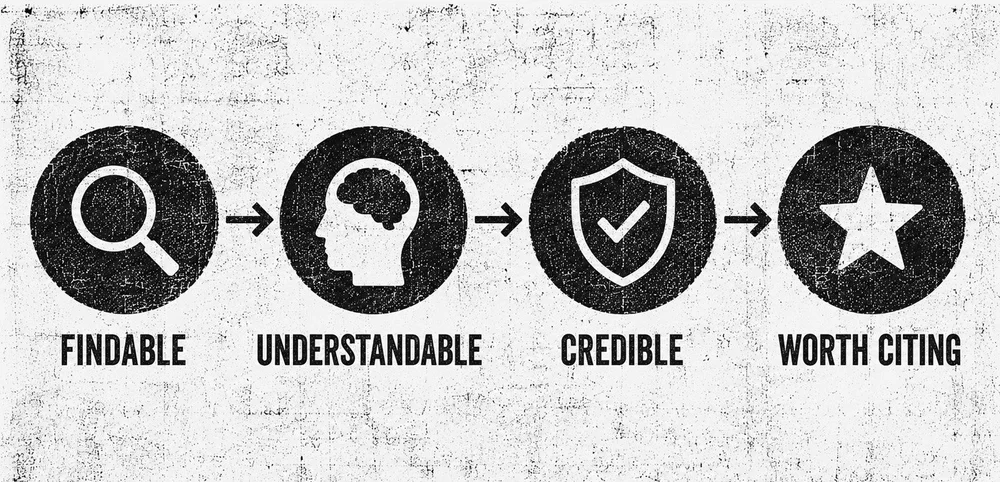
Findable → Understandable → Credible → Worth Citing.
1. Be findable.
The boring technical stuff still matters.
Your pages need to be accessible.
Your site needs to be crawlable.
Your important information should not be buried somewhere machines cannot access.
Your business name, location, products and areas of expertise should be clear.
Good traditional SEO remains useful.
AI did not kill SEO.
It changed what can happen after retrieval.
2. Be understandable.
This one is underestimated.
Machines need to understand what you are actually about.
Humans do too.
If you manufacture whisky in Speyside, say so.
If you specialise in offshore engineering, say so.
If you run a hotel in Aberdeenshire, say so.
If you have won an award, identify the award.
If you have particular expertise, demonstrate it.
Avoid turning every sentence into meaningless corporate gobbledygook.
3. Be credible.
You can claim you are brilliant.
That is advertising.
If credible independent sources say you are brilliant, that is evidence.
Press coverage.
Reviews.
Professional organisations.
Customers.
Universities.
Industry publications.
Awards.
Research.
This is why PR, reputation and search are beginning to collide.
An AI system attempting to answer a question needs corroboration.
A brand existing only inside its own website is making a claim about itself.
A brand consistently appearing across credible independent sources begins to look like an established entity.
4. Be worth citing.
Here is the part marketers cannot manufacture indefinitely.
Have something useful to say.
Original research.
Useful statistics.
First-hand experience.
A strong explanation.
A distinctive point of view.
A genuinely useful framework.
Which suggests a beautifully unfashionable AI strategy:
Do not write for robots.
This is where GEO could repeat twenty years of SEO mistakes.
We have seen this film before.
Once marketers discovered that Google could send traffic, enormous quantities of dreadful material appeared designed primarily for algorithms.
Keyword stuffing.
Link farms.
Endless near-identical articles.
“10 AMAZING WAYS TO...”
Search engines then spent years trying to stop people gaming them.
The same temptation now exists with AI.
Manufactured mentions.
Fake authority.
Scaled content.
Supposedly independent recommendations created only to influence machine outputs.
The arms race has already begun.
Don't join it.
You cannot control the answer.
This may be the most important thing an AI-search consultant should tell you.
AI outputs are probabilistic.
Ask the same question differently and you may get different sources.
Ask again later and the answer may change.
Different AI systems use different retrieval methods.
Different models behave differently.
The underlying systems themselves are changing quickly.
So be suspicious of anyone promising:
“We can guarantee your brand appears in ChatGPT.”
They can't.
And do not forget the buyer.
There's another danger.
Marketers become fascinated by the new intermediary.
Google.
Facebook.
TikTok.
Amazon.
ChatGPT.
And suddenly the entire strategy becomes about pleasing the machine.
But the machine is not buying your stuff.
Or booking your hotel.
Or appointing your accountant.
Or hiring your agency.
A human is.
AI search is another route through which humans discover and evaluate businesses.
The fundamental marketing problem remains unchanged.
Be known.
Be remembered.
Be available.
Be credible.
Be easy to buy.
AI search is another form of availability.
Traditionally, marketing science talks about mental availability.
How easily does a brand come to mind in a buying situation?
AI introduces something adjacent.
Call it machine availability.
When someone asks an AI about your category:
How easily can the system retrieve enough credible information to bring your brand into the answer?
That is not a replacement for mental availability.
It is another route towards it.
Because the final destination is still a human mind.
What should a small business actually do?
Nothing particularly exotic.
- Make sure your website clearly explains who you are and what you do.
- Publish genuinely useful material around the things you know.
- Answer the real questions customers ask.
- Use clear headings and straightforward language.
- Keep important facts accurate and current.
- Build legitimate reviews.
- Earn press and industry coverage.
- Develop relationships with credible organisations.
- Create case studies.
- Publish evidence.
- Make your expertise visible outside your own website.
- Keep doing ordinary SEO properly.
Notice what is not on that list.
“Hire someone to put secret GEO keywords into your website.”
Do not measure only citations.
This is another emerging trap.
“My brand appeared in 37% of AI prompts this month.”
Interesting.
But then what?
Did anyone notice?
Did it change perception?
Did they investigate you?
Did they visit?
Did they buy?
AI visibility is an intermediate measure.
Not a business outcome.
We have been here before with impressions, clicks, likes and followers.
FFS let's not make the same mistake again.
Common mistakes
Treating GEO as completely different from SEO.
Much of the foundation remains the same: accessibility, clarity, relevance, authority and useful content.
Producing hundreds of AI-targeted articles.
More content does not necessarily mean more authority.
Trying to manipulate forums and communities.
Manufactured mentions may look clever in the short term but undermine trust and can quickly become spam.
Believing your website is enough.
What credible independent sources say about you may matter enormously.
Obsessing over citations.
Being cited is not the same as influencing an answer, let alone influencing a buyer.
Believing anyone has cracked the algorithm.
There is no single AI-search algorithm.
There are multiple rapidly changing systems.
TheSignalWorks View
AI search optimisation is real.
The hype and certainty surrounding it is not.
We would resist turning GEO into another mysterious technical discipline requiring businesses to learn another collection of acronyms.
The practical principles are much simpler.
Be findable.
Be understandable.
Be credible.
Be worth citing.
Do those things because they are useful to people.
The machines will have a considerably easier time understanding you as a consequence.
And perhaps that is the most useful thing about AI search.
After twenty years of brands producing content designed to impress algorithms, the new technology may eventually reward businesses for doing something rather old-fashioned.
Actually knowing something worth finding.
Key Takeaways
- AI search is changing discovery from a list of links into generated answers.
- Traditional SEO still matters.
- AI visibility depends on more than your own website.
- Clear expertise, credible third-party mentions and useful original material all help machines understand a brand.
- Do not confuse AI citations with commercial outcomes.
- No one can guarantee stable placement inside AI answers.
- The strongest practical framework is simple: Findable → Understandable → Credible → Worth Citing.
Frequently Asked Questions
What is GEO?
GEO stands for Generative Engine Optimisation. It describes attempts to improve how brands and content appear inside AI-generated answers.
Is GEO replacing SEO?
No.
Traditional SEO remains foundational because AI systems still need to discover, retrieve and understand information.
Can a business guarantee it appears in ChatGPT?
No.
AI answers are probabilistic and vary by system, question, retrieval method and time.
Does creating lots of content help?
Not necessarily.
Useful, distinctive and credible content is more valuable than producing large volumes of near-identical material.
Do third-party mentions matter?
Potentially a great deal.
Independent references, reviews, journalism and other credible sources can help establish what a business is and whether it is trustworthy.
What should small businesses prioritise?
Clear website structure, useful expertise, accurate information, conventional SEO, credible third-party mentions and genuinely useful content.
What is machine availability?
It is a useful way of describing how easy it is for an AI system to retrieve enough credible information about a brand to consider including it in an answer.
Further Reading
- Google Search documentation on AI features and SEO
- Research on Generative Engine Optimisation and AI citation behaviour
- Byron Sharp — How Brands Grow
- Jenni Romaniuk — Better Brand Health
- Daniel Kahneman — Thinking, Fast and Slow
Related Knowledge
About TheSignalWorks
At TheSignalWorks, we help organisations make sense of new technology without confusing novelty with strategy.
Because the question isn't whether AI search matters or not.
It does.
The question is whether your business is:
Findable. Understandable. Credible. And worth citing.